
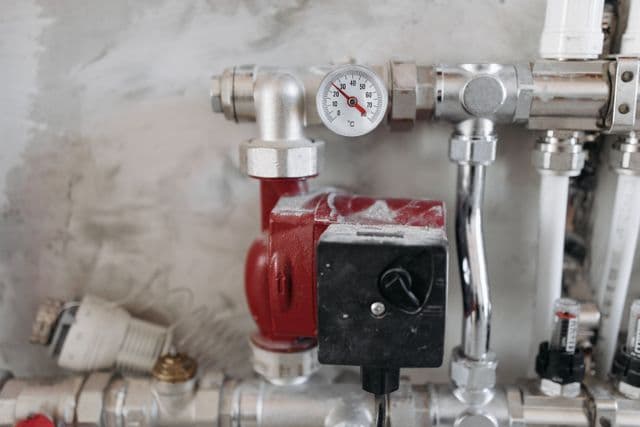
The sudden failure of a domestic boiler to produce domestic hot water (DHW) during peak winter demand constitutes a critical infrastructure emergency. This malfunction is rarely spontaneous; it is typically the culmination of progressive system degradation, including hydrodynamic pressure drops, calcium carbonate (limescale) accumulation within the plate heat exchanger, diverter valve mechanical failure, or NTC thermistor degradation. Ignoring these primary indicators leads inevitably to a total system lockout and costly component replacement.
""A boiler lock-out is an engineered safety sequence, not a random anomaly. It activates in response to low hydraulic pressure, restricted flow, or sensor failure. Repeatedly forcing the system to ignite without diagnosing the root cause guarantees permanent thermal damage to the primary heat exchanger.""
When a boiler fails to ignite or maintain stable water temperatures, immediate technical intervention is required to prevent irreversible component failure. Arvand Termo Tec executes rapid hydraulic diagnostics, pressure correction, diverter valve servicing, and component replacement across Mestre, Venice, and Padua.
Request a quoteSystem Pressure Diagnostics and Hydronics
Optimal hydraulic pressure must be maintained between 1.0 and 1.5 bar when the system is cold. If the analog or digital gauge indicates a lower value, the system lacks sufficient fluid mass to initiate safe ignition, triggering a low-pressure lockout. To rectify this, slowly manipulate the filling loop valve located beneath the boiler until the needle reaches the optimal 1.5 bar threshold, then isolate the valve securely. Caution is mandatory: over-pressurizing the system beyond 2.5 bar will trigger the pressure relief valve (PRV) to discharge fluid externally.
Thermostat, RF Communication, and Power Verification
Before disassembling hardware, verify the command chain. Ensure thermostat batteries possess sufficient voltage and that the programmed thermal setpoint exceeds the current ambient room temperature. For wireless units, verify the radio-frequency (RF) pairing between the thermostat and the boiler receiver. Finally, confirm the primary fused spur or electrical isolation switch supplying the boiler is fully engaged and the internal fuse remains intact.
Diverter Valve and Heat Exchanger Diagnostics
If the boiler provides central heating but fails to produce domestic hot water, the diverter valve is likely jammed. This motorized component directs heated water to either the radiators or the domestic hot water tap. If the valve motor burns out or the internal mechanism calcifies, hot water delivery ceases. Furthermore, if hot water is produced but fluctuates rapidly between hot and cold, the secondary plate heat exchanger is restricted by limescale buildup, requiring chemical flushing.
System Reset Protocol and Hard Lockouts
Depress the "Reset" button on the boiler control fascia. This action reboots the electronic printed circuit board (PCB), clearing transient software lockouts (e.g., temporary gas supply interruption). If the unit mandates multiple reset sequences within a 24-hour operational period, the system has entered a hard lockout condition. This signifies an imminent, critical component failure—such as a seized circulation pump or a blocked flue—requiring immediate technical extraction.